
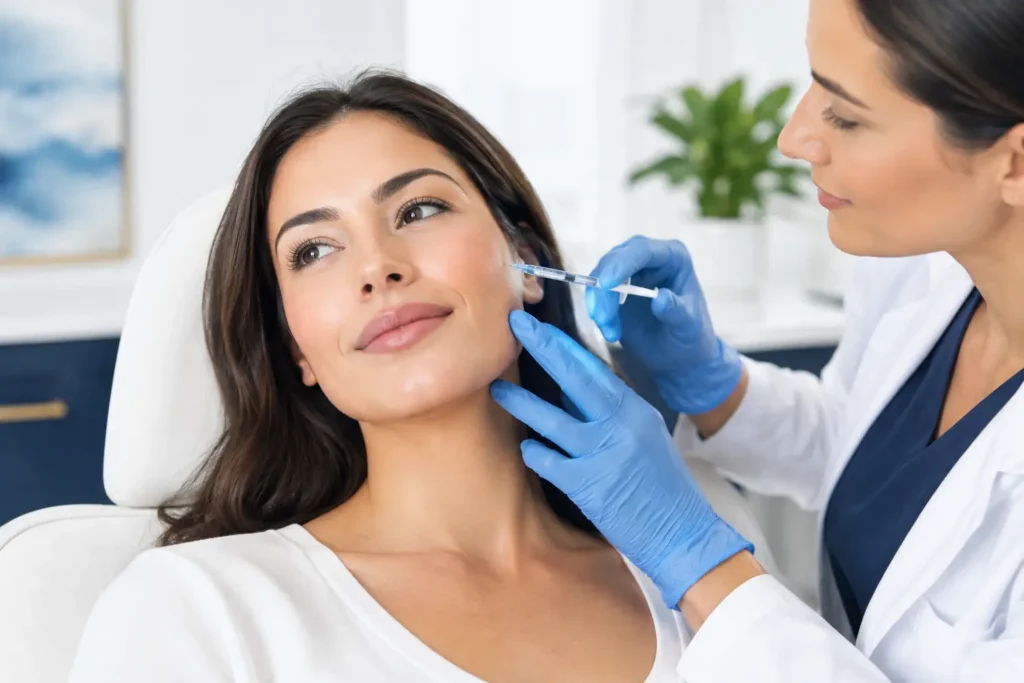
Facial balancing is not about changing every feature or chasing a trend. It is about looking at how the forehead, eyes, cheeks, nose, lips, chin, and jawline relate to one another. The best injectables for facial balancing are the ones selected for your facial structure, skin quality, movement patterns, and personal goals – not simply the treatment that is most popular online.
For some people, restoring subtle cheek support can make the lower face look more proportionate. For others, relaxing a strong muscle may soften lines or improve facial harmony without adding volume. A thoughtful plan considers the full face and respects what already makes you look like yourself.
What Facial Balancing Means
Facial balancing uses non-surgical treatments to create better proportion between facial features. A provider may assess areas that have lost volume over time, muscles that pull strongly, or contours that could benefit from subtle support. The goal is usually refinement, not a dramatic change.
Balance is personal. A chin that appears small in profile may affect how the jawline looks. Hollowing through the midface may make the lower face seem heavier, even when the jaw itself has not changed. Lip treatment may be appropriate for one person, while another may get a more balanced result by treating the cheeks, chin, or surrounding areas instead.
This is why facial balancing should begin with an in-person assessment and an open discussion of your goals. Photos, facial proportions, skin elasticity, and your expressions all matter. What looks balanced at rest should also look natural when you smile, speak, and animate your face.
The Best Injectables for Facial Balancing Depend on the Goal
Injectables generally fall into two main categories for facial balancing: dermal fillers and neuromodulators. They work differently, and many personalized plans use one category, not necessarily both.
Dermal fillers for support and contour
Dermal fillers are gel-like injectable treatments that may add or restore volume in targeted areas. Many are made with hyaluronic acid, a substance naturally found in the body that attracts water. Depending on the product and treatment area, fillers may help improve contour, support, or softness.
In facial balancing, fillers may be considered for the cheeks, temples, lips, chin, jawline, or folds around the mouth. A provider may use filler to restore midface volume that has diminished with age, enhance chin projection, define a jawline, or bring more proportion to the lips.
The trade-off is that more filler is not always better. Overfilling can make features look less natural or place unnecessary pressure on tissues. In some cases, the most appropriate plan is to treat conservatively, reassess after swelling resolves, and build gradually if needed. Results vary based on anatomy, product selection, treatment technique, and how your body responds.
Neuromodulators for expression-related balance
Neuromodulators are injectable treatments that temporarily reduce activity in specific muscles. They are commonly used for expression lines in the forehead, between the eyebrows, and around the eyes. They may also be used in carefully selected areas to address muscle tension that affects facial shape or symmetry.
For example, a provider may evaluate whether strong lower-face muscles contribute to a square or tense appearance, or whether certain muscle patterns pull one area of the face more than another. When appropriate, neuromodulators may help soften these movements while preserving natural expression.
This treatment requires precision. Too much relaxation or treatment in the wrong area can affect expression or function. A qualified medical provider should assess muscle activity in motion, not just study a still photograph.
When both approaches may make sense
Facial aging and facial balance are rarely about one issue. Volume changes, skin quality, bone structure, and muscle movement can all influence the final appearance. A person with a flat-looking midface and strong frown lines, for instance, may benefit from a plan that considers both support and movement.
Still, combination treatment is not automatically the best choice. A personalized approach should identify what will make the greatest difference with the least unnecessary treatment. At MedSmart Wellness Centers, aesthetic planning is guided by the same principle used throughout medical wellness care: understand the individual first, then build a plan around their needs.
Areas Commonly Considered in Facial Balancing
A full-face evaluation helps prevent a common mistake: treating the feature that bothers you without considering why it looks that way. A concern in one area may begin elsewhere.
The midface is often assessed because the cheeks provide structural support to the center of the face. When this area loses volume, under-eye hollows, smile lines, and lower-face heaviness may become more noticeable. Strategic support may create a rested appearance without directly treating every line.
The chin and jawline are also important for profile balance. A subtle change in chin projection may affect how the nose, lips, and jaw appear in relation to one another. The goal should be proportion, not an exaggerated or copied look.
Lips require the same restraint. A balanced lip treatment considers upper and lower lip proportion, the area around the mouth, dental structure, and the way the lips move. For some patients, improving hydration or definition may be more appropriate than adding noticeable volume.
The forehead, brow area, and eyes are evaluated for muscle movement and facial expression. Neuromodulators may help soften lines while keeping the face approachable and expressive. Results should look like you on a good day, not like a different person.
What a Safe, Personalized Evaluation Includes
The right injectable treatment starts with a detailed conversation about your health history, medications, allergies, past aesthetic treatments, and goals. Tell your provider if you have had previous fillers or neuromodulators, including treatments performed elsewhere. This information can affect planning and safety.
Your provider should examine your face from multiple angles and while you make normal expressions. They should explain which areas may benefit from treatment, which ones should be left alone, and why. You should also understand common side effects, expected recovery considerations, and when to contact the office after treatment.
Not everyone is a candidate for every injectable. Certain medical conditions, active skin infections, pregnancy or breastfeeding, prior reactions, and other individual factors may mean treatment should be postponed or avoided. Your provider can help determine whether injectables fit your overall health situation.
A responsible plan also recognizes that injectables are not a replacement for healthy skin habits or broader wellness care. Sleep, nutrition, sun protection, stress, hormone changes, weight shifts, and skincare can all influence how the face looks over time. For patients who want a more comprehensive approach, medical wellness and aesthetic care can complement one another.
Questions to Ask Before Facial Balancing Treatment
Before moving forward, ask what concern the treatment is designed to address and what alternatives may be reasonable. Ask whether the plan is focused on support, contour, muscle movement, or a combination. It is also helpful to ask how the provider will keep the result conservative and how future treatments will be reassessed.
You should never feel rushed into treating multiple areas. Good aesthetic care is collaborative. It leaves room for your preferences, your budget considerations, and the possibility that a smaller plan may be the right starting point.
Choose Balance Over a Trend
The most successful facial balancing plans are built around your proportions rather than a changing social media ideal. A subtle adjustment may help you look more rested, supported, or defined while preserving the features that feel familiar to you.
If you are considering injectables in Aventura or nearby South Florida communities, schedule a free consultation with MedSmart Wellness Centers or call (305) 842-2244. A personalized assessment can help you understand your options and decide whether a conservative, medically guided plan is right for you. Aging is natural, but how you age is a choice – and thoughtful care begins with understanding what supports your confidence and health.